From Tesla to AEIR
There are few ideas in the history of human innovation that are both as old and as young as wireless energy transmission.
Old, because the concept was first demonstrated in the late nineteenth century. Young, because until now humanity has never possessed the scientific, industrial, computational, or security infrastructure required to take it beyond the stage of a fragile experiment. For more than one hundred years it has lived in a suspended state, a brilliant idea without a home, a breakthrough lacking a system, a possibility in search of a path to being useful at scale.
That begins to change today.
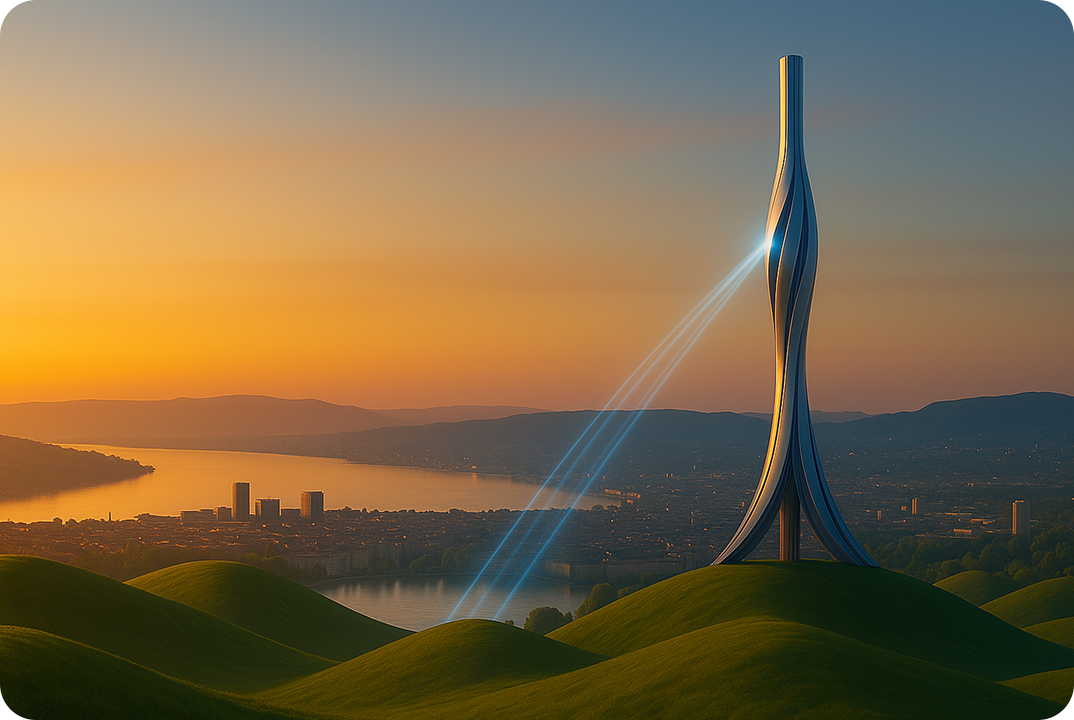
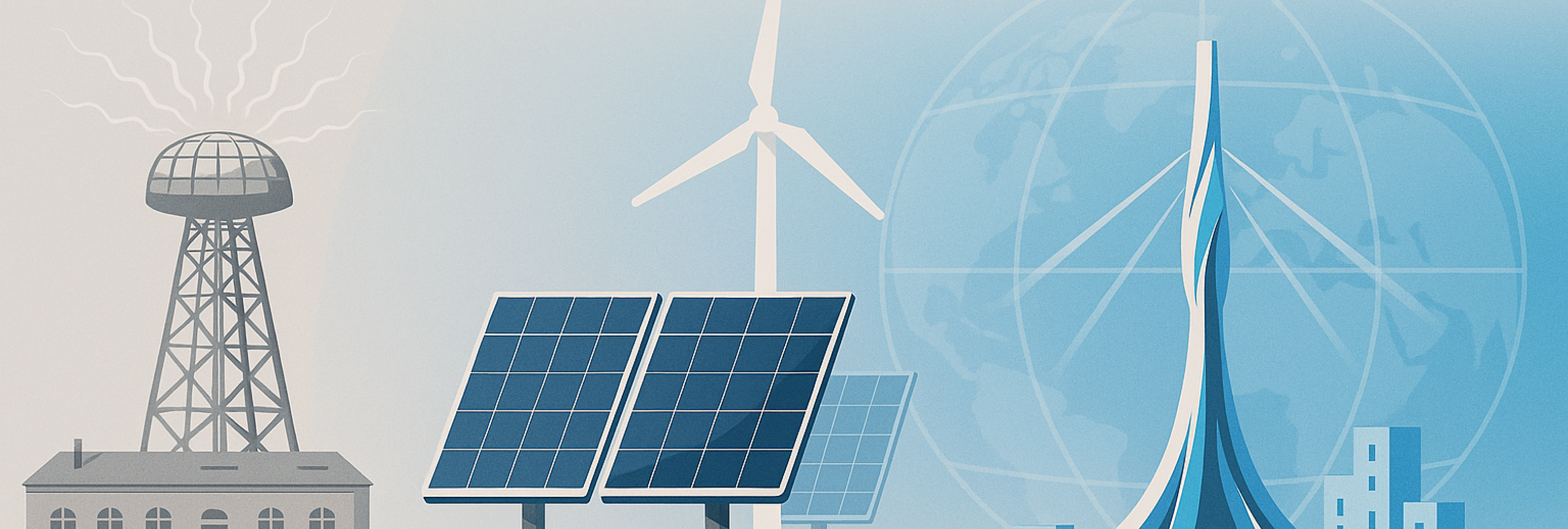
AEIR’s wireless energy technology, developed in stealth since 2017 and accelerated through joint R&D with a world leading intergovernmental partner since 2023, is turning that long dormant concept into an engineered reality. It connects Nikola Tesla’s original insight to a future where energy travels as clean, safe and steerable light at planetary scale.
Here, photons do not simply arrive as sunlight on a rooftop solar panel, but are guided intentionally as carriers of energy through the air to any receiver that needs them.
This connection between photons and electrons is not incidental. It becomes central to understanding how wireless energy has evolved, because solar panels already convert light into electricity at global scale. AEIR simply completes the loop, but in the opposite direction.
This is the journey from Tesla to AEIR, and the era of Energy in Air.
Before Wireless: How Electricity Became a Cage of Copper
Modern electricity began as a story of wires.
Michael Faraday’s work on electromagnetic induction in the nineteenth century made it possible to convert mechanical motion into electrical current. Thomas Edison built the first direct current power stations and distribution networks, turning electricity into a commercial service, but only over short distances.
Nikola Tesla changed the scale. His alternating current induction motor and polyphase AC system enabled efficient high voltage transmission over long distances, which quickly became the backbone of national grids. The AC grid solved one problem and created another. It made electricity abundant, but locked it into a rigid infrastructure of copper, aluminum, substations, and towers.
Power could travel across a continent, yet still had to find its way to the last meter through a socket and a cable.
That last meter is where Tesla’s imagination refused to stop.
Tesla’s Wireless Dream: Wardenclyffe and What Really Happened
By the 1890s Tesla was experimenting with high voltage coils and resonant transformers, demonstrating wireless lighting and long distance discharges. He believed the Earth itself could serve as a conductor and that electrical energy might be transmitted without wires over substantial distances.
Wardenclyffe Tower on Long Island was the physical expression of that belief. Built in the early 1900s and funded initially by J. P. Morgan, Wardenclyffe was intended as a combined wireless communications and power transmission station. Tesla’s vision went far beyond simple telegraphy.
He envisioned and spoke openly about:
- Transatlantic communication without cables
- Global broadcasting of information
- Eventually, the provision of useful power at distance
History remembers Wardenclyffe as a promise that never materialised. Costs escalated as Tesla tried to upgrade the design. Marconi’s radio successes undercut the case for investing further. Morgan and others declined additional funding amid shifting priorities and financial disagreements. Construction slowed and then stopped. The tower was demolished in 1917.
Tesla himself never stopped talking about wireless power and global energy systems. In essays like “The Problem of Increasing Human Energy”, he sketched ideas for planetary scale energy management and harnessing the power of the sun’s energy, long before such concepts were mainstream.
After his death in 1943, his personal papers and effects were seized by the United States Office of Alien Property and reviewed by government experts before many were eventually released or archived. That seizure is a matter of record. The speculation that followed is not what this article is about.
What matters for us is this: Tesla saw energy’s direction of travel. He understood that electricity did not have to be chained to metal in order to move. But the world around him was not ready to turn that insight into infrastructure.
Why the Idea Stayed Stuck for a Century
Tesla’s wireless dream remained unrealised not because it lacked imagination, but because it lacked an ecosystem and backers willing to share his vision of a wireless energy future. Several key conditions were missing for most of the twentieth century.
Photonics and materials
Efficiently converting electrical energy into tightly controlled and safe pulses of light, transmitting it over long distances, and converting it back requires advanced photonics, optics, or semiconductors. These only reached the necessary performance and reliability in recent decades.
Computation and real time control
Safe wireless power at meaningful scales requires precise shaping and steering of mass of photons, continuous sensing of the environment, and instant fail safe responses. That demands fast embedded compute, advanced algorithms, and robust networks that did not exist in Tesla’s lifetime.
Safety and standards
Early high voltage experiments were uncontrolled and spectacular. Modern systems must operate within strict exposure limits and safety standards, interact safely with people and equipment, and of course satisfy regulators. That framework took decades to develop.
For most of the last century, wireless power lived either as a science fiction idea or as a set of near field conveniences: induction cooktops, charging pads, and RFID tags. Useful at centimeters or at best meters, not hundreds of meters or kilometers.
Short range
One notable chapter in this period was the early 2000s work at MIT that led to WiTricity. Their demonstrations showed that short range magnetic resonance could light a bulb and transfer modest power over a few meters, creating global attention. Although it proved that wireless power was physically possible, it also revealed the limits of near field systems.
Efficiency dropped sharply with distance and practical deployment never scaled beyond charging pads. Our approach at AEIR represents a different path altogether, using photonics and long range directional light rather than magnetic resonance, which opens an entirely new domain of distance and control.
In the meantime, another revolution was taking shape on rooftops.
The Solar Analogy: From Photons to Electrons and Back Again
Solar panels give us a clean, intuitive story. Photons, or light particles, from the sun strike a semiconductor. Each photon frees an electron. Those electrons are guided through circuits to do work. In essence, light becomes electricity.
AEIR starts from the same physics and closes the loop.
- Capture clean energy, primarily from solar and other renewables.
- Convert electrical energy into coherent light using photonic transmitters.
- Steer that light through the air to multiple receivers that convert it back to electrical power exactly where it is needed.
- The system preserves high wireless transmission efficiency above 95% across operational long-distance ranges, supported by intelligent storage and control systems that minimise losses and ensure clean energy is available the moment a receiver requests it.
Solar turns photons into electrons.
AEIR turns electrons back into photons, routes that light with precision through defined transmission paths, and converts it into electrons again at the receiving point, delivering exactly what is needed, no more and no less.
In efficiency terms, each stage is deliberately optimised, from directional control that minimises atmospheric loss to receivers designed for the transmission wavelength, preserving energy across the entire chain.
Light stops being a passive resource that simply arrives on earth, and instead becomes an active carrier we aim, allocate, and control.
This is Energy in Air. Or simply, AEIR.
AEIR as a System
AEIR’s wireless technology has been under development in stealth mode since 2017, shaped by scientific research and advances in photonics. In 2023, this work entered a new phase: focused prototype development aimed at real world deployment, carried out together with one of the world’s most respected intergovernmental organizations in secure test environments.
At a high level, AEIR is based on a four layer stack.
Generation
Clean energy generation is managed by AEIR’s parent company Sync Neural Genesis AG, and captured from distributed renewable sources through: rooftops, open land, floating solar, and eventually orbit through space based solar power (SBSP).
Intelligent storage and AI control
Battery systems managed by advanced algorithms that forecast demand, balance loads, reduce waste, ensure unparalleled efficiency and guarantee that energy is available when the wireless grid needs it.
Wireless transmission through light
AEIR antennas convert electrical energy into carefully controlled pulses of light. Embedded receivers within 250 meter up to 1km range convert that light back into electricity. The system includes continuous sensing, targeting, and automatic safeties that can cut power or redirect pulses in real time.
Data integrity
The integrated SyncChip records each unit of generated and transmitted energy with verified time and location data. This creates a trustworthy audit trail that insurance firms, financial institutions, and operators can rely on for continuous monitoring, risk assessment, and proof that critical systems remain operational.
Blockchain tokenization
Our energy tokenization and blockchain platform Netzium builds on this verified data layer. It allows each measured flow of clean energy to be metered, accounted for, and tokenized at a fixed unit value of 100 kWh.
Tokenization here is not a replacement for traditional metering. It solves a different problem. Wireless energy can move between zones, storage nodes, and distributed solar sources in ways that fixed meters cannot follow. Netzium creates an energy ledger that traces origin, movement, and ownership across the entire wireless mesh. Each token carries a clear, verifiable record of where the energy came from, where it moved, and who controls it.
Carbon market
This same measurement layer also enables accurate and tamper resistant verification of carbon credits. One of the largest challenges in today’s carbon markets is validating renewable energy production and confirming that a claimed offset is genuine. By linking solar generation, intelligent storage, and wireless energy distribution to a transparent and verifiable data structure, AEIR can provide high fidelity proof of clean energy production and corresponding carbon reductions.
This positions AEIR not only as an energy infrastructure, but as a trustworthy verification platform for next generation carbon markets.
Essentially, AEIR turns energy into something that can move with the speed and intelligence of information.
AEIR Antennas: Range, Efficiency and Mesh Network
What sets AEIR apart is not just that it sends energy through the air, but how.
Range
The standard AEIR antennas are designed to create roughly 250 m x 250 m x 250 m invisible zones of power. These zones function like giant cubes that interconnect with one another to form a seamless wireless energy grid. Larger antenna configurations extend beyond 1,000 meters in range.
Achieving safe and controllable power delivery across these distances has not been accomplished in practical wireless systems before, and represents a meaningful and unprecedented step forward for the field.
Efficiency
Achieves system level transmission efficiencies above 95% under controlled conditions, supported by intelligent batteries managed by AI that balances loads and optimises charge cycles.
Directional control
AEIR does not flood a space with energy. It uses advanced mathematics, sensing, and physics to guide light along defined transmission paths from antenna to receiver in a precisely controlled manner. This keeps exposure predictable, reduces losses, and ensures that only the intended receivers collect power within their assigned zone.
Point to multi point and mesh
One antenna can serve many receivers in its coverage zone. Multiple antennas can be linked so that energy flows across a mesh, similar in spirit to how packets move across the internet. Power is no longer bound to a single fixed route. It can be routed, re-routed, and balanced across a network of light-carrying antennas.
Safety and savestops
Sensors and algorithms constantly monitor the mass of photons, the environment, and the receivers. If anything deviates from safe parameters, energy flow can be reduced or stopped in fractions of a second.
The system is designed to operate well within global safety exposure limits and remain below 5G-equivalent thresholds, ensuring compatibility with human environments and sensitive equipment.
This is wireless power built to serve homes, ports, cities, and eventually space to Earth links.
AI, GPUs and the New Energy Appetite
In parallel with these advances in photonic algorithms and accompanying hardware, the world is experiencing an explosion in AI and high performance compute.
Training and running large AI models requires vast GPU clusters and data centers that draw enormous amounts of power. As AI systems rapidly spread into finance, medicine, logistics, entertainment, and national security, the demand for compute, and therefore energy, has become near insatiable.
Several things follow from this.
- Data centers are becoming critical energy centers, not just information hubs.
- The nature of energy demand is increasingly characterized by spikes and varies significantly with location, mirroring the patterns of compute workloads.
- New forms of high level compute, including early quantum and quantum adjacent systems, are entering the mix and adding further complexity.
Managing such a landscape with static and outdated grids is difficult. It requires something closer to a real time, adaptive energy internet.
This is where AI does double duty.
The same class of advanced algorithms that train large models also makes it possible to run AEIR’s real time energy control layer. AI can monitor thousands of pulses and receivers, predict load demand, reshape flows, and trigger savestops at the speed of light. It can treat energy as a continuous data stream, balancing safety, efficiency, and availability as conditions change.
Without mature AI and high speed compute, a dense mesh of AEIR antennas would be nearly impossible to coordinate. With them, it becomes manageable. Energy in Air is both powering the AI era and being orchestrated by it.
A Convergence of Maturing Technologies
The timing of AEIR is not accidental. It sits at the intersection of several technology curves that are peaking together.
Renewables at global scale
Solar and wind have moved from fringe to mainstream. The question is no longer whether we can generate enough clean power, but how flexibly and resiliently we can move it.
Photonics and power electronics at maturity
We now know how to generate and steer controlled light paths with the precision and reliability that high power wireless transmission demands.
AI and advanced compute
There is both a massive energy demand from AI itself and the availability of AI as a control layer that can handle the complexity of a real time wireless grid of antennas, receivers, and storage. We are also edging into an era where quantum computing may further change the profile of compute and energy needs.
The space economy and cheaper launch
Reusable rockets and space logistics have lowered the cost of putting mass into orbit. Large solar farms in space, once purely theoretical, are now being studied and prototyped seriously. They can harvest sunlight continuously, above clouds and night. The remaining major hurdle is how to transmit that power back to Earth reliably and sustainably.
That last obstacle is not a communications problem. It is a wireless energy problem.
AEIR’s technology is designed to address that gap.
Real World Use Cases on Earth
On the ground, AEIR focuses first on use cases where wires are a limitation.
Public wireless charging
In stations, airports, and malls, AEIR antennas create zones where devices quietly recharge without cables or pads. People simply exist in an energy field that keeps their tools alive.
EV charging without plugs
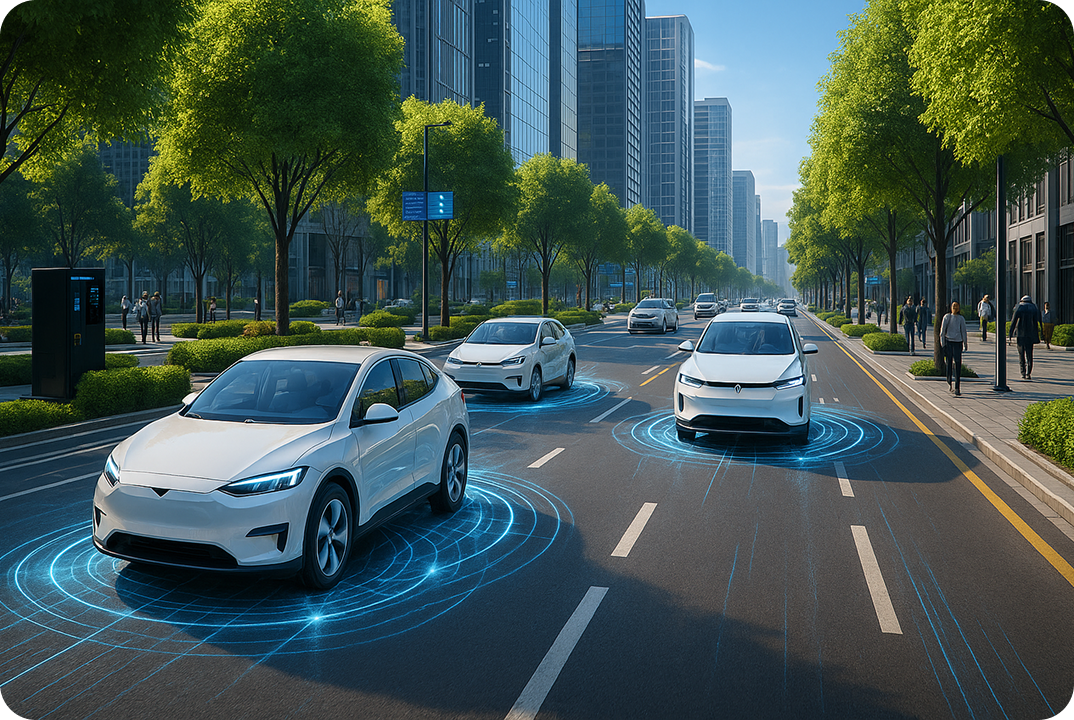
Streets, parking lots, and depots become charging environments instead of lines of posts and cables. Vehicles receive power while parked or queued, reducing the need for heavy cabling and manual connection.
Ports and smart maritime infrastructure
Harbors and marinas are harsh environments for physical infrastructure. AEIR technology can supply ships and port systems with clean energy over water, without vulnerable cables.
Hospitality and premium spaces
Hotels, resorts, and venues can remove visible wires and chargers from their designs while offering constant, invisible energy availability for guests and internal systems.
Smart cities, industry, and logistics
Sensors, cameras, robots, drones, and other mobile systems no longer need to return to a base station to charge or be tethered to fixed infrastructure. AEIR gives them roaming power, which in turn unlocks more advanced automation.
When power no longer depends on wires, autonomy on Earth becomes a bridge beyond the atmosphere.
From Ports to Orbit: Space Based Solar and the Kardashev Scale
Looking upward, the same principles extend to orbit.
Space based solar power imagines large solar arrays outside Earth’s atmosphere, where sunlight is constant and intense. Those arrays convert light into electrical energy and then into controlled light transmissions directed toward receivers on Earth or in orbit.
For decades the idea was appealing but economically out of reach. Launch costs were too high, and the space industry was too small. Today, with reusable rockets and a rapidly expanding space economy, placing large solar structures into orbit has become realistic.
The bottleneck has shifted. It is no longer about lifting solar arrays into space. It is about bringing that energy back to Earth safely and efficiently.
This is where the Kardashev scale offers a useful frame. Proposed by astrophysicist Nikolai Kardashev in 1964, it classifies civilizations by how much energy they can harness and control. Humanity, despite our perceived technological achievements, is still Type 0, using only a small fraction of the energy naturally available on our planet. A Type I civilization can access and distribute the full energy budget available on its planet. A Type II civilization can harness the entire energy output of its solar system’s star, often imagined as a Dyson Swarm or other stellar-scale energy architecture. Even more abstract is Type III, which refers to harnessing the energy of an entire galaxy.
Space based solar power is one of the clearest pathways toward the Kardashev scale’s Type I threshold. It offers continuous sunlight, free from clouds and night cycles, and in quantities far beyond what ground based panels can harvest. The remaining challenge is transmission: how to deliver that power to Earth in a stable, controllable, and safe manner.
AEIR’s Vega class concepts are aimed precisely at this hinge point. Gigawatt scale wireless transmission across tens of thousands of kilometers turns space based solar from an elegant idea into a candidate for real infrastructure. It is the kind of advance that begins to move a Type 0 civilization closer to Type I, where energy becomes a programmable planetary resource rather than a geographically constrained commodity.
From rooftop panels and marinas, to dense city meshes, to orbital links, the same core idea scales upward: energy as light, guided intelligently.
Carrying Tesla’s Legacy Without the Myth
Tesla’s story is often wrapped in legend. The facts are already remarkable.
He helped build the AC grid that powers much of the world. He designed motors and systems that still underpin modern industry. He explored wireless communication and power decades before they became mainstream. He tried, and failed, to build a cathedral of wireless power at Wardenclyffe. His papers were seized and scrutinised by authorities after his death.
What he did not have was mature photonics, AI, global renewables, orbital infrastructure, or a world prepared to reorganize its energy systems.
AEIR does not claim to finish Tesla’s work in a literal sense. It carries his legacy in a different way.
- By taking wireless power out of the realm of spectacle and into the realm of infrastructure.
- By grounding Energy in Air in rigorous physics, conservative safety thresholds, and real regulatory pathways.
- By designing for mesh, for point to multi point, for integration with renewables, and for eventual links between Earth and space.
- By using AI not only as a consumer of energy, but as the nervous system that keeps the wireless grid stable.
Tesla saw that electricity did not have to end at the socket. AEIR exists in a world that can finally do something about that vision.
From Tesla to AEIR and the Era of Energy in Air
The story of wireless energy transmission is not a straight line from a lone inventor to a final product. It is a long arc through copper dynamos, Wardenclyffe’s unfinished tower, semiconductor lasers, GPU clusters, reusable rockets, rooftop solar, and photonic antennas.
In that arc, Tesla marks the moment when humanity first glimpsed that power could move without wires. AEIR marks the moment when that glimpse begins to crystallise into viable systems: antennas on buildings and ships, wireless zones in cities, energy meshes across regions, and eventually light pulses that link space based solar farms to the ground.
From Tesla to AEIR and the era of Energy in Air, one idea is constant.
Energy does not belong only in walls and wires. It belongs wherever intelligent life needs it, in the right amount, at the right moment.
The work of this century is to guide it there, cleanly and safely, through the air itself on channels of light.
And so, standing on the threshold of this new chapter, we return to the first words that have always marked the beginning of creation.
Let there be light.
By Misha Lederman
CMO, SYNC & AEIR